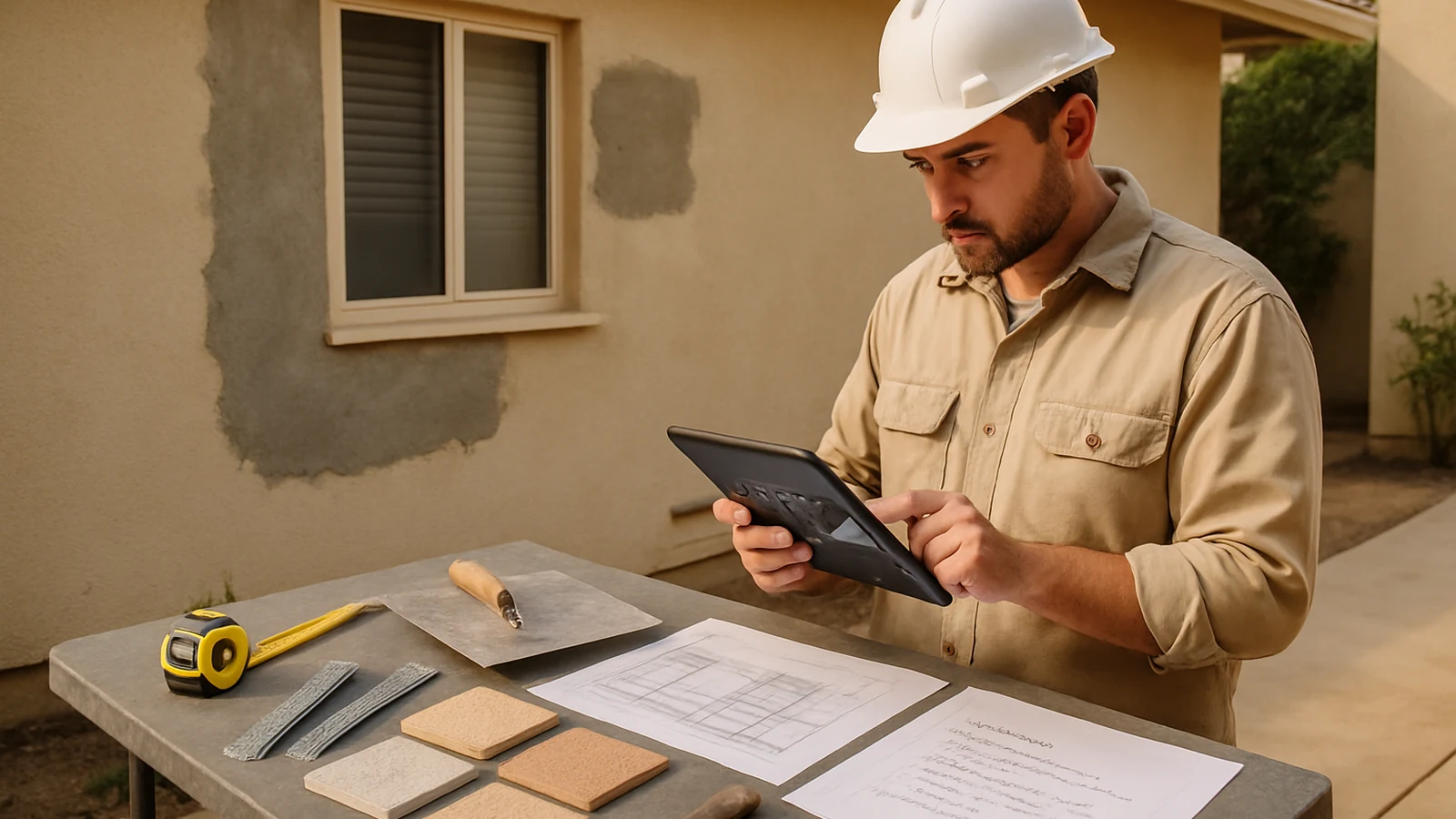
AI Estimating Software for EIFS Contractors in California: Faster Los Angeles Facade Bids From Photos, Plans, and Scope Notes
See how California EIFS contractors can use AI-assisted estimating workflows to organize photos, plans, voice notes, exclusions, and follow-up without losing control of the final bid.


AI estimating software for EIFS contractors in California is useful when it helps turn messy project information into a clear, reviewable bid: wall areas, openings, foam shapes, accessories, finish scope, access notes, exclusions, and follow-up reminders. It should not replace the EIFS contractor's judgment. The goal is to help the estimator move from lead intake to a professional proposal faster, with fewer missed scope items.
For a Los Angeles EIFS contractor, speed matters because many bids start with incomplete information. A property manager sends facade photos. A GC emails partial elevations. A homeowner leaves a voice note about cracks, water staining, or a finish match. If those inputs live in separate text threads, emails, and notebooks, the estimator spends too much time rebuilding the job story before pricing anything.
Key takeaway: EIFS estimating needs scope control, not just a faster calculator
EIFS bids can look simple from the outside: measure the wall, pick the finish, price the square footage. In the field, the money is usually in the details. A usable estimate needs to separate new EIFS from repair work, patching from full assemblies, finish-only work from base coat and mesh, and cosmetic cracking from possible water intrusion.
Good estimating software for EIFS contractors should help organize the estimating package around those decisions. It should make it easier to ask: What assembly is being touched? What substrate is behind it? Are there returns, reveals, control joints, sealant transitions, parapets, windows, penetrations, foam trims, or access constraints? What is included, what is excluded, and what needs verification before the number is final?
That is where AI can help. It can read photos, plans, videos, and voice notes into a structured draft so the contractor reviews a scope instead of starting from a blank page.
Why this matters for California EIFS contractors
California EIFS work often involves more than a flat wall quantity. In Los Angeles, contractors may be bidding apartment facades, commercial storefronts, mixed-use buildings, hillside homes, HOA properties, and tenant improvement exteriors. Those jobs can include tight access, staged work around occupied buildings, color and texture matching, patch limits, and coordination with waterproofing, windows, sealants, painters, and sometimes structural or code-related review.
California also creates real estimating context that should be captured in the bid notes:
- Moisture and drainage details: Coastal and marine-influenced areas make flashing, terminations, sealants, and drainage assumptions important.
- Movement and cracking: Seismic movement, building age, substrate condition, and prior patching can affect repair scope and warranty language.
- Fire and local requirements: Some projects near higher fire-risk areas may require local review of exterior assemblies and materials.
- Energy and envelope expectations: Exterior wall work may intersect with California energy and building-envelope requirements depending on the project type.
- Access and logistics: Los Angeles jobs often need careful notes for scaffolding, lifts, parking, traffic, business hours, tenant coordination, and protection of adjacent surfaces.
A bid that ignores those items may look competitive but create trouble after award. A bid that documents them clearly gives the contractor a better chance to protect margin and set expectations.
A practical EIFS estimating workflow from lead to follow-up
Use this workflow when a lead comes in from photos, plans, or a fast walkthrough.
1. Capture every input in one job record
Put the photos, elevation drawings, sketch, customer request, voice memo, and site notes together before pricing. For example: "South elevation, second floor, cracks around three windows, match existing fine sand finish, GC to provide lift access" is a different job than "remove failed EIFS at all elevations and install a new drainage EIFS assembly."
2. Separate the scope by work type
Break the bid into sections such as inspection/open-up allowance, demo, substrate repair by others or by you, foam board, base coat, mesh, reinforcing mesh, accessories, finish coat, sealant coordination, painting or coating if included, cleanup, and protection. Do not bury repair risk inside one lump sum without notes.
3. Measure more than field square footage
Square footage matters, but EIFS estimates also need openings, returns, bands, trim shapes, parapet conditions, inside/outside corners, reveals, control joints, and penetrations. A facade with many windows can take more labor per square foot than a clean warehouse wall.
4. Flag unknowns before they become change orders
Common unknowns include substrate damage, hidden moisture, attachment condition, previous non-compatible repairs, missing flashing, exact finish match, and who is responsible for window or door sealants. Put the unknowns in the estimate so the customer understands what is priced and what requires further inspection.
5. Build access and sequencing into the proposal
For Los Angeles EIFS work, access can change the job. A small patch may need a boom lift, swing stage, sidewalk protection, tenant notices, or after-hours work. Your estimate should show whether access is included, provided by others, or priced as an allowance.
6. Send a clean proposal and follow up with context
The proposal should explain the included areas, materials or assembly assumptions, finish expectations, exclusions, and next step. Follow-up should not just say, "Any update?" A better follow-up says, "We included patching at the marked second-floor window returns, access by GC, and excluded hidden substrate repair until opened. Do you want us to price that allowance separately?"
Common mistakes that cost EIFS contractors money
- Estimating EIFS like paint or basic stucco. EIFS has its own assembly details, accessories, reinforcement, finish assumptions, and moisture-risk language.
- Missing transitions. Windows, doors, parapets, rooflines, balconies, penetrations, and sealant joints often drive labor and risk.
- Not documenting finish-match limits. Existing texture, fading, patch size, and elevation breaks should be explained before work starts.
- Ignoring access. Lift rental, scaffolding, protection, staging, parking, and tenant coordination belong in the estimate.
- Letting photos stay unorganized. If the estimator cannot tie photos to elevation areas and scope notes, the bid gets fuzzy.
- Skipping follow-up. Many EIFS bids die quietly because the contractor never follows up with a useful scope clarification.
How Estimado AI helps EIFS contractors estimate faster
Estimado AI is built as AI estimating software for contractors who want faster estimates without giving up review control. For an EIFS contractor, that means using job photos, blueprints, videos, and voice notes to draft a structured estimate package: scope of work, material and quantity breakdowns, labor review areas, clarifying questions, exclusions, and a customer-ready proposal.
The contractor stays in the loop. Estimado should act like a junior estimator at your side: it organizes the project, catches missing questions, drafts the estimate, and gives you something practical to review. You still approve the quantities, assemblies, labor, markup, exclusions, and final price before anything goes to the customer.
For EIFS work, that review step matters. A tool can help sort facade photos and draft line items, but the contractor still knows whether the substrate looks suspect, whether the finish match is realistic, whether the access plan is workable, and whether the customer needs an inspection allowance before a hard number.
Next step
If your EIFS team wants cleaner estimate drafts from photos, plans, and field notes while keeping the final review in your hands, join the Estimado AI waitlist. Estimado is being built for contractors who want to respond faster, protect scope, and keep professional control over the final number.
FAQ
Is AI estimating software accurate enough for EIFS bids?
It can help create a faster, more complete first draft, but EIFS contractors should still review every quantity, assembly assumption, access note, exclusion, and labor factor. The safest workflow keeps the contractor as the final estimator.
What should an EIFS estimate include?
A strong EIFS estimate should include wall areas, openings, returns, accessories, foam or insulation assumptions, base coat, mesh, finish coat, sealant coordination, access, protection, cleanup, exclusions, and unknowns such as hidden substrate or moisture damage.
Can AI estimate EIFS from photos?
AI can help organize photos, identify visible conditions, and draft scope notes. It should ask for measurements or plan details when the photo alone is not reliable enough to price the job.
Why is California different for EIFS estimating?
California EIFS contractors often need to account for local permitting, building-envelope expectations, fire-area concerns where applicable, seismic movement, coastal moisture conditions, access logistics, and city-specific inspection requirements.
Should EIFS contractors use estimating software for follow-up?
Yes. A good follow-up workflow reminds the contractor to send a clear next-step message tied to the scope, exclusions, allowance questions, and decision points instead of sending a generic reminder.